
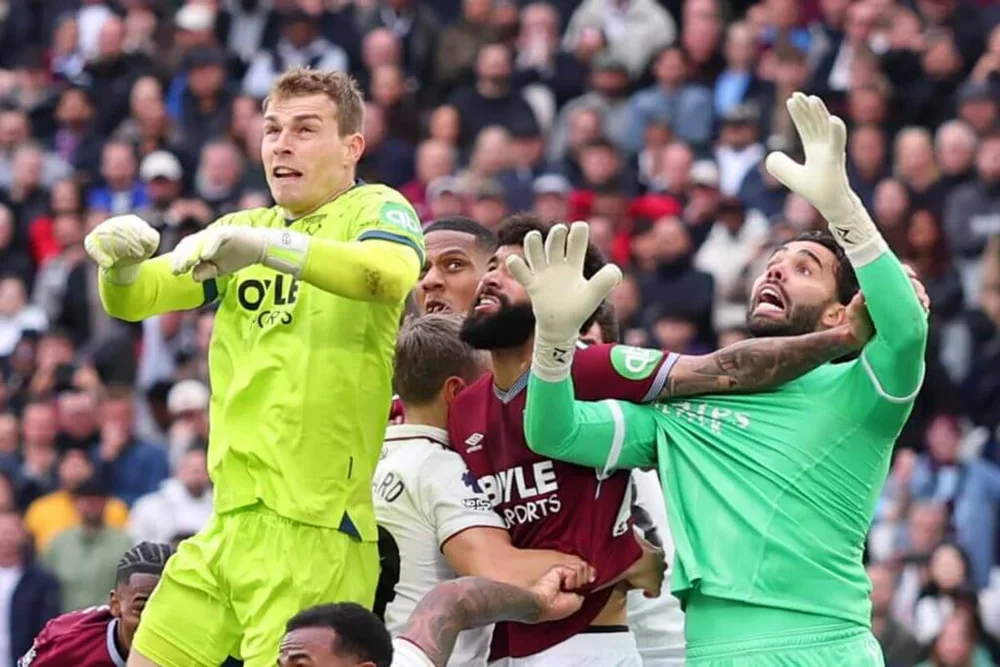
Pablo of West Ham was judged to have fouled Arsenal goalkeeper David Raya during a key moment in Sunday’s match. Marc Atkins/Getty Images
Cinematic endings, outstanding quality, and big moments are how many want Premier League matches and titles to be decided. But a five-minute VAR delay to analyze a potential foul on Arsenal goalkeeper David Raya from a corner hardly feels like Hollywood.
There was uproar in the final minutes at the London Stadium on Sunday, as Callum Wilson’s late equalizer for West Ham was eventually disallowed. One West Ham player, Pablo, had his arm across Raya’s chest while holding his left forearm, and another, Jean-Clair Todibo, was tugging at his shoulder.
This scenario—goalies being swarmed by attackers—has been prevalent throughout the Premier League season. The proportion of inswinging corners has jumped from 48% in 2022-23 to 71% this campaign. Meanwhile, outswingers are becoming almost extinct, as frequent as short corners now, with most set-pieces resembling a rugby scrum or wrestling match, packed with bodies around the goalkeeper.
So put aside the endless VAR debate for a moment. The Premier League has a deeper issue: corners are broken.
Three statistics sum up the situation. Even with two matchweeks remaining, this season ranks highest since 2018-19 for inswinging corners (2,503), fouls on goalkeepers (146), and goals from corners (174).
“I think we need to change the rules,” says Graham Scott, a former Premier League referee for a decade before retiring last year, now a writer at The Athletic. “It’s become a license for almost anything to go. When I started refereeing, if someone made physical contact with a goalkeeper right in front of goal, your instincts were to give a free kick—that was the safer option. People would shrug their shoulders and roll their eyes, saying ‘goalkeepers are overprotected,’ but they accepted it, and they wanted their own keeper protected too. That’s changed over the past two or three seasons. Now, being a goalkeeper gives you no privileges at all.”
Attacking teams have weaponized blocking to target specific zonal markers and create runs for their best headers of the ball. Arsenal and Aston Villa were unique a few years ago, among the first to hire set-piece coaches and prioritize inswingers. Now, nearly every Premier League side has assistants focused on this aspect of the game.
Defenders have become equally aggressive in grappling and holding. West Ham could argue that Arsenal trio Declan Rice, Martin Odegaard, and Leandro Trossard were also committing fouls during the Jarrod Bowen corner from which they scored their disallowed equalizer on Sunday.
The Premier League sets a “high threshold” for fouls and, before this season, announced an “enhanced recognition of holding offenses” as one of several points of emphasis for referees.
The physicality of English football is a source of pride and identity, setting it apart from Europe’s other major leagues. However, it becomes a challenge when teams, in an era of marginal gains, try to stretch the rules to their maximum. Liverpool head coach Arne Slot and Crystal Palace manager Oliver Glasner have both noted how fouls are called much more readily at corners elsewhere in Europe.
Were there also fouls on West Ham players at their last-minute corner? (Alex Pantling/Getty Images)
None of Europe’s other top-five leagues come close to the Premier League in the number of inswingers. The league’s unique style, combined with the evolution of set-piece tactics, has created a situation where the corner kick has become more about physical battles than skill. The problem isn’t just the number of goals, but the frequency of stoppages and controversies that undermine the flow of the game.
How did this happen? The rise of specialist set-piece coaches, the obsession with marginal gains, and referees giving attackers more leeway have all contributed. Defenders have had to match that aggression, leading to a tug-of-war that often ends with VAR intervening.
What’s the fix? One option is to enforce existing rules more strictly, particularly holding and obstruction. Another is to change the laws to protect goalkeepers better, perhaps by creating a no-go zone around them. Or the league could introduce a directive similar to rugby’s “ruck,” where players must be on their feet. The key is to strike a balance that preserves the Premier League’s physical nature while preventing corners from becoming a farce.
Scott suggests a simple change: “If we go back to protecting the goalkeeper more, that might be the quickest fix. Or we could make it clear that any contact initiated by an attacker before the ball arrives is a foul, regardless of strength. It’s about consistency.”
Until then, expect more VAR delays, more controversy, and more debates about whether corners are broken beyond repair. But with the season winding down and the title race heating up, the league has a short window to act. The aesthetic appeal of the game depends on it.